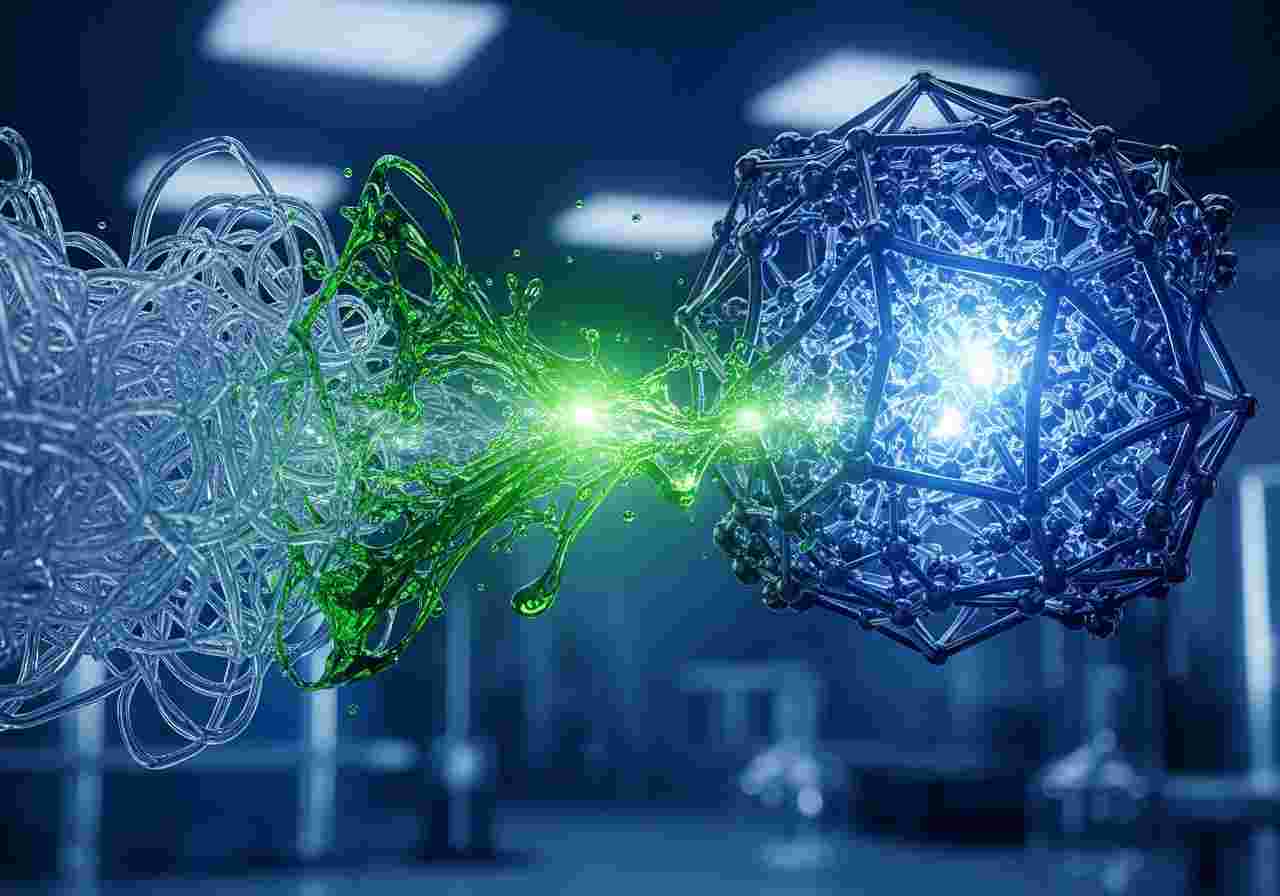
Just imagine a world in which plastic waste just fades away. Not in a landfill. Not in our oceans. But fragmented by little, specially designed molecular motors. It is no longer science fiction. It is the direct product of making a gorgeous scientific find in artificial intelligence. The very AI that solved the protein-folding code is now coming up with all-new proteins. Its mission? To develop enzymes which can deal with our most intractable pollution. Our future in terms of environment is being redefined by this new discovery.
The Leap Out of prediction to creation
The “protein folding problem” was a struggle of scientists over decades. It was a huge ordeal to predict 3D shape of a protein based on the sequence. Then the AlphaFold2 of DeepMind came. It was a breakthrough of a discovery. Then we were able to forecast structures with breathtaking precision. However, prediction was not the only step. Magic truly hit its peak when a new question was posed by the researchers. Is it possible to apply this knowledge not only to decipher the code of life, but also write it?
The grammar of life programme learning AI Took place in 2014
The following wave of AI applications, such as RFdiffusion and Chroma, was a step closer to prediction. The principles of protein physics were taught to these systems. Think of it like this. The AI is no longer able to merely forecast the word to follow in a sentence but can actually produce a full and flawless novel with only one command. It produces millions of all new, steady protein structures. These are templates of the molecules that have never been present in nature. This salvo into the creative is what is likely to be the biggest finding in synthetic biology this century.
A Molecular Scissor of Plastic
The proof is in the plastic. Take the example of PET the polymer of billions of water bottles. In 2024, scientists were able to create a PET-deconstructing enzyme through AI that could break down PET in several days. This finding makes a centuries-long process take hours. The AI has developed a protein that has an ideal active site. This location is similar to a molecular scissor, which cuts the strong bonds of the plastic. Scientists then used this computer blueprint into an actual organism. They had introduced the gene into a general soil bacterium. The result? An enzyme called this plastic eating. This case study demonstrates that the concept has ceased to be theoretical.
- We are no longer confined to such as we can discover in nature. It is now possible to design exactly what we need and this is according to Dr. Anika Sharma who is a biochemist at the Institute for Protein Design.
Outside The Bottle: A Green Chemistry Arsenal
The possibilities of this technology are much bigger than plastic. Other challenges of major magnitude can use the same generative process. AI currently is developing enzymes to green manufacturing. These modified catalysts are capable of substituting the toxic heavy metals in industry. In addition, researchers are designing proteins that will trap carbon dioxide much better. Even enzyme work on tough agricultural waste to be used as biofuels has been done. Every new protein is a new discovery that has enormous potential. This becomes a fresh set of cleaning tools to clean our world.
The Overwhelming Scale-Up Issue
However, a major gap remains. It is one thing to design an ideal enzyme in a computer. Another is to make it work in an industrial and real-life environment. The AI provides us with a key, but the lock is locked in a factory that is an anarchical, unpredictable, and chaotic environment. Increasing production is a massive challenge. We are to maintain the stability of enzymes in molten plastic vats. The whole process should also become cost effective. Here the brilliant discovery confronts the ugly reality of engineering.
- The AI creates the ideal race car. It is our duty to construct the road and the pit crew to win it and we are Ben Carter, an industrial bioprocess engineer.
A Responsible Discovery
Might comes with all power great responsibility. There is a risk associated with the capability of designing biological agents. It is possible that the same tools may be abused. The scientific community is therefore taking the initiative to construct safety measures. One of them is the so-called biocontainment. This entails biological modification of microbes to be reliant on an artificial amino acid. In the event they get out of the lab, they just cannot live. This vital finding in the safety department makes our solutions not new problems.
Our Final Verdict
It is a monumental discovery by AI. It puts into our hands a mighty weapon with which to set to rights. However, it is not a free pass out of jail. It does not excuse us of the necessity to decrease consumption and become better managers of waste. This is an invention that is going to stand through human ingenuity. Whereupon we have to counter that ingenuity with wisdom and healthy regulation. The actual revelation will be whether we can use this new power intelligently to have a clean planet.