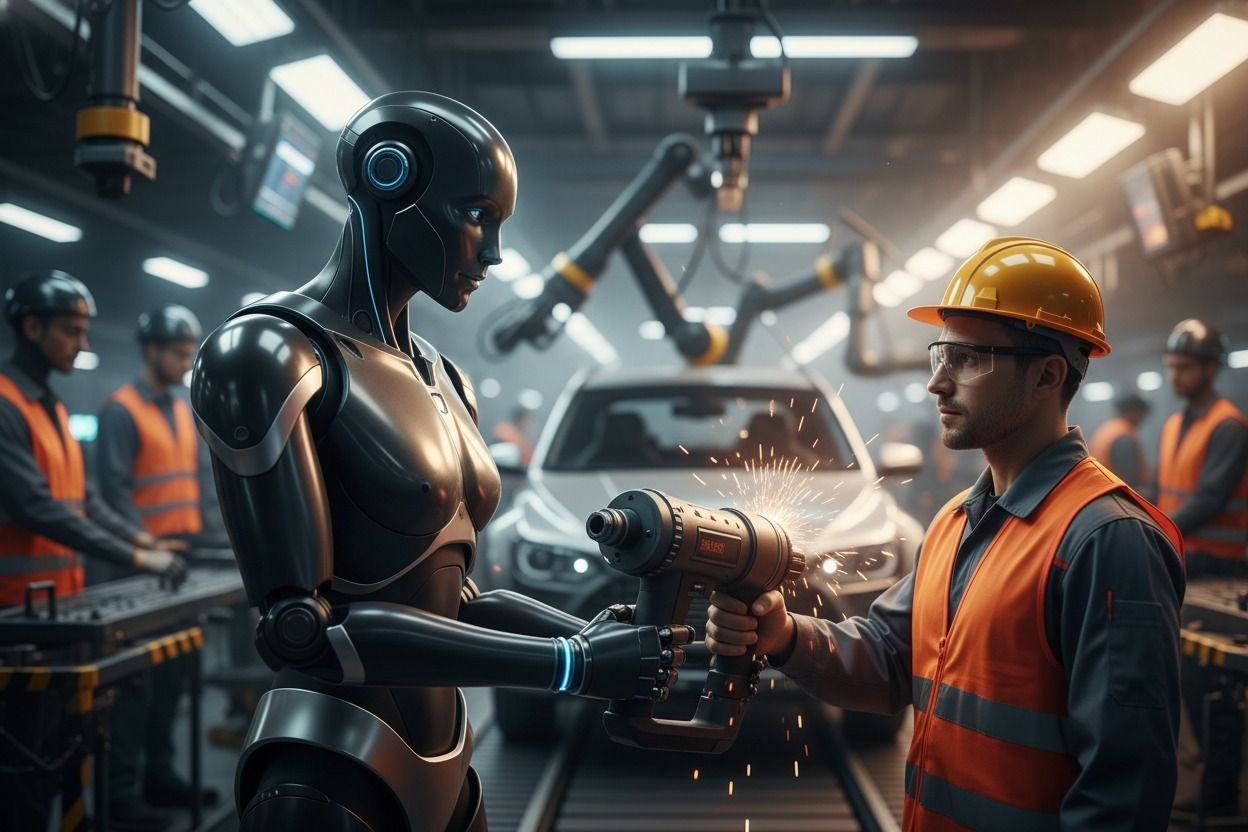
Introduction: More Than Sci-Fi
Just think about a robot that does not only weld on a car chassis but it can also fill up a shelf and assist a person that has fallen on the floor and needs to get up. This isn’t a fantasy anymore. Robots that resemble humans are coming out of the laboratory. What changed? This gold rush is being driven by a great storm of AI innovations and scared reality requirements. Tesla to Amazon are the leading competitors who are placing bets worth billions. Why is the age of humanoid robot finally coming, we should seek to know.
The AI Brain Transplant
Humanoid robots were awkward machines over the decades. They could walk, but barely. The actual issue was the lack of intelligence. They were not able to cognize their world. After that, there was a crucial change. Humanoid robots were provided with a new brain due to generative AI and large language models. They are suddenly able to deal with natural language commands. Humanoid robots are able to learn through video demonstrations. It is not just improved program. It is a kind of jump in thinking capacity. The body finally has a mind.
Professional Perspective: Dr. Anya Sharma, a robotics professor at Carnegie Mellon, tells us that it is the end of mechanical knowledge, as robots have become cognitive beings. It is no longer a question of walking on two legs. It is a question of reasoning and making prompt amends to unpredictable situations.
A Labor Crisis Resurvey
Why the urgent push now? Look at the numbers. The manufacturing industry in the world produces a shortage of more than 2 million employees. The construction is dealing with an ageing workforce. These aren’t just statistics. They become existential threats of entire industries. A humanoid robot is a promising panacea. They are created in accordance to a human-made and human world. Stairs, tools, door handles, they fit in just fine. Companies consider them the ultimate flexible automation tool.
Case in Point: BMW recently entered into an agreement with Figure AI in order to deploy their humanoid robot, the Figure 01, in a South Carolina facility. The goal? Robotize hard, time-consuming procedures. Here is an epistemological testimony by a manufacturing giant.
The Future of Warehouses is Here
Let’s get specific. Consider an Amazon fulfillment facility. The number of tasks to be done is enormous. A robot in the shape of a human being would be able to take the truck out. Then it may transfer to picking station. Lastly, it would be able to handle inventory. This kill app is this multifunctionality. It gets rid of a dozen single-purpose machines. The economic case is getting too strong. The efficiency saving might be colossal.
Raw Data: According to a recent report by ABI Research, more than 150000 humanoid robots will be shipped in a year time coming 2030. It is no longer a niche market. It is the following computing platform.
The Employment Uncanny Valley
Naturally, this creates enormous questions. What of the human beings working there? Will these machines produce new jobs or kill old jobs? The answer is messy. Certain positions in the manual labor will certainly be lost. New roles are however coming up. We will require huge numbers of robot supervisors, maintenance and trainers of AI. It will be a bumpy transition. This change must be ready in the society not retro-actively.
- Personal Opinion: I have addressed factory managers who are excited and fearful. They view the possibility of tremendous productivity improvement. They also are afraid of the human cost and technical complexity of managing a hybrid workforce.
Beyond the Factory Walls
The desire does not end at manufacturing. Agility robotics is testing Digit Agility logistics robot. Apptronik is testing healthcare applications via Apollo model. The end result is a general-purpose machine. Consider a humanoid robot which will be useful in disaster response. Or offer care to the aged at home. The potential is limitless. We are creating a new race of smart, physical assistant.
Conclusion: The Genie is Out
It is not a race to create an ideal human clone. It is to produce a multitasking, cost effective employee. The technology has hit the inflection point. The funding is flowing. The partnerships with corporations are agreed upon. We may argue about the morality, but we can do nothing to halt the tide. It is no longer a matter of whether or not the humanoid robot will come to be. It’s a question of “how fast.” We are living in the time of building the future of work, off-the-servo at a time. Are we ready for it?